Showing posts with label book review. Show all posts

Thursday, February 17, 2011

Book Review: Emotionally Healthy Twins

 Emotionally Healthy Twins: A New Philosophy for Parenting Two Unique Children

Emotionally Healthy Twins: A New Philosophy for Parenting Two Unique Children has a definite point of view, so reading it can be thought-provoking, even if you don't agree -- sort of like listening to Ron Paul, or to a vegan. Friedman throws down the gauntlet early in the book, with this suggestion of how to announce the impending arrival of twins.
PARENT-TO-BE: I have wonderful news! Brad and I are going to be the parents of two babies!
MOTHER-IN-LAW: What do you mean? Are you saying you're having twins?
PARENT-TO-BE: Yes, but we're already thinking about them as two separate children, because that's what they are: two separate babies born at the same time.
MOTHER-IN-LAW: What's wrong with calling them twins?
PARENT-TO-BE: Nothing's wrong with it. It's just that Brad and I feel strongly about relating to our babies as two distinct children rather than as a pair. And we hope that our friends and family will treat them as individuals as well.
MOTHER-IN-LAW: Hmmmm. Okay, well congratulations, anyhow!
"Two separate babies born at the same time" -- if only there were a more succinct way of saying that. Oh, wait, there is --- throughout much of the book Friedman uses the term "same-age siblings". The term would probably be less grating if she said something like, "I'm using this term interchangeably with the term 'twin' to drive home the point that they don't need to be treated like a pair anymore than non-twin siblings." But instead we're left to guess at the reasoning behind her goofy coinage. Other than language weirdness, here are my other problems with this book:
  • She gives no consideration to a cost/benefit analysis of her favorite prescription: alone time between a parent and one twin. I agree, it's great when I get to spend one-on-one time with one of my sons, but I can't imagine hiring a babysitter for one of them to provide this alone time with the other. Besides, don't you get this time naturally over the course of the day -- or do everybody else's twins synchronize their sleep schedule much better than ours do?
  • She places such emphasis on the potential problems that she fails to discuss the nature of an "emotionally healthy" twin relationship. Maybe as a psychotherapist, it's natural for her to dwell on problems created by too little individuation, but it would be good to find examples of how twins relate to each other in a healthy way.
  • Here's an example she gives about emotionally unhealthy twin behavior: "David's friends would often call him to get together -- to go to the park or movies or a party -- and at times David didn't go out with them because he felt badly that Jonny wasn't included." But wait -- that example is of her own children, whom she raised with this allegedly wonderful "new philosophy". So either the philosophy doesn't work, or some amount of twin drama is inevitable and parents need to focus more on managing it than on preventing it by treating their children as if they aren't twins. Possibly both.
  • She makes almost no distinction between different types of twins -- identical versus fraternal, boy/girl versus same-sex. Perhaps she feels that the distinctions don't matter in terms of how you should treat your twins. But certainly they matter in terms of how twins are perceived -- identical twins are more likely to be perceived as "one and the same", and I suspect conflict among twins is discouraged more in girl/girl twins than in other configurations.
This list of complaints shouldn't indicate that I found the book useless -- her passionate advocacy for the "two unique children" was, at times, eye-opening. When she talks about the need to learn each child's individual personality, she warns against the common pitfall of defining a twin's personality only in terms of his sibling. So you'd have "the active one" and "the quiet one", when what you really mean is "more active/quiet than the other one" -- not really a way of treating someone as an individual. That hadn't occurred to me before, and it's something I'll keep in mind.

Ultimately, though, this book left me lacking a clear picture of what raising emotionally healthy twins is like. Perhaps, as Christina suggested, the next book should be a more generic one rather than one solely about twins. Perhaps Friedman is right that the "twin mystique" is a source of a lot of twin problems -- a viewpoint that would argue against running a website devoted to twinness.

Twinometer: 6/10.

Monday, January 17, 2011

Book Review: Raising Twins

Raising Twins: What Parents Want to Know (And What Twins Want to Tell Them)

I haven't done any book reviews for twinpanic.com since the twins were born -- mainly because I haven't had a lot of time for reading. I kept thinking about one book that I had read after I had tired of the reviews and decided to go back and look at it again.  Of course, I had read so many books, it was difficult to remember which one it was!

After much searching, I discovered that it was Raising Twins: What Parents Want to Know (And What Twins Want to Tell Them).  Upon re-reading, I see that this book has several things going for it, and one major strike against it.

  • The "What Twins Want to Tell Them" subtitle refers to the numerous interviews with twins sprinkled throughout the book.  I am reminded of a one-credit course I took on the politics of East Asia when I was in college.  The course had a succession of guest speakers, and midway through the class, my classmates pointed out that we finally got one who was Asian.  In other words, it's all well and good to hear from the "experts", but interviews with actual twins give a much-needed perspective.
  • The book takes a developmental approach.  For various ages, it first explains what a child can normally be expected to do at that particular age, then it revisits the topic to tell you how twins may differ.  It sounds obvious, but I found this approach to be unique among the books I've read, and it was a really good way to understand what to expect.
  • Tied in with the previous point, the book goes into a lot of detail to explain why twins need certain things.  In my review of Double Duty, I questioned the advice not to refer to your kids as "the twins" and suggested it was not that different from referring to any set of siblings as "the kids".  Raising Twins, on the other hand, explained that twins in particular struggle with differentiating themselves from their "co-twin", so it can be particularly important to use their individual names, in a way it might not for singleton siblings.
  • The book addresses twin development all the way through high school, which is somewhat unusual for a book about twins.  Most such books handle the first year, or the first few years, and, I suppose, assume that parents who survive that long can handle things for themselves.  I was interested to read how the twin relationship continues to play a role, even for teenagers.
Alas, the last positive point is also a negative point.  Because the book describes development spanning a period of eighteen years, there is very little about each specific age.  If I wanted to know a lot about six-month-old twins (I do!  I do!), there was just one tidbit, although a very interesting one.  (Children at this age may start to use transitional objects to comfort themselves when separated from their mother.  For a twin, this object may actually be his or her sibling.)  I can't imagine lugging this book around for eighteen years, only to pull it out every six months and remember what advice it has at this point.  For this reason, I cannot give the book my fullest endorsement.

Twinometer: 8/10.

    Tuesday, August 10, 2010

    Needful Things

    My neighbor is expecting. Granted, she's "only" having a singleton, but we're very glad for her, and admire her wisdom in easing into parenting with just one starter child. Plus it'll be nice to have another baby on the street come October; we may borrow her baby and pretend to have triplets. But, like many inexperienced mothers (including myself), she had little idea what items were necessities, in what quantity, or when to buy. With twins, this conundrum seems more dire, as twinfants come early and you've less time to plan, let alone shop.

    So, here is my list of items I've found absolutely useful in the first month, and just prior. Starting with the most helpful reading materials.

    Baby Bargains: Ok, so it costs $18 unless you catch it on sale or at a thrift store, but it claims to save you at least $250 or your money back. I did the math, and lo and behold, can account for at least that much in savings based on direct advice from this Bargain series gem. Of note to twinfant parents: most baby hauses will give you a 10% discount. We bought two cribs at Great Beginnings (a Germantown store recommended by Baby Bargains), which qualified us for 10% off anything and everything else we wanted to purchase there, whenever we felt like driving 20 miles for it. We saved at least that much by visiting Great Beginnings, partly because we encountered a 20% discount over a holiday weekend. So that store recommendation alone brought us to $200. We also amassed savings by not buying many items which BB pooh-poohs as needless, even dangerous. BB is also a ratings book, which ranks and grades most popular baby brands. I bought this book early and lived by its due diligence. My only complaint are the cutesy puns and asides which are more useless than a diaper stacker.
    Checklist for your New Baby: Now, this one is out of print. I first read it at my local library, and found a used copy at Amazon. They have several. It's concise, direct, and yes, actually provides checklists of items in different categories (furniture, bath time, etc.). Although it's a good workbook, it is out of print, and a bit out of date (last revision 1998); you'll have to make corrections as you read (think "Internet" instead of "Mail Order"), but the shopping lists are still totally relevant.

    Now, just about everyone knows what to get for a baby. Clothes, someplace to sleep, blankets, some bottles with formula) and a few toys or books will get you pretty far into the first month.

    1. Clothes for baby. We've done well enough with 25 onesies (12 for a singleton), 6 (3) pairs of socks, a few (3) hats, and about 24 (12) receiving blankets. That's all a newborn baby really needs, and it's enough to keep you from doing laundry more than every other day. Don't overbuy -- babies add about half a pound a week, which means most of those adorable outfits you dithered over won't last two months. Hats and socks don't really get dirty, so again, don't overbuy.

    2. Clothes for mom: see prior post on Plus-size motherhood. Add nursing bras, night bras, and nursing tops and PJs as appropriate.

    3. A place to sleep. Technically any four-sided, sturdy box with a soft-ish (but not too soft) lining will do. People have used dresser drawers, and if you think that will get you in trouble with Social Services, read pg. BLANK of BOOK. More usually a crib, bassinet, moses basket, or co-sleeper is purchased.

    4. Bottles and food. Baby needs only milk (yours) or formula for the first six months. Bottles are purely for the convenience of the breastfeeding mother who wants an occasional afternoon off . Formula-fed babies will need formula, and water with which to mix it (or premixed). I use distilled water and organic powdered formula because that's who I am.

    5. Toiletries: Soap/shampoo mixture, diaper cream, and skin lotion are necessary, but don't forget that cute little bag of toiletries and medical supplies, which include hairbrushes (probably not needed) and thermometers (definitely needed). Buy more than one nasal aspirator bulb, though you'll get some from the hospital.

    6. Diapering goods. Diapers. Diapers. More Diapers. The average newborn gets a new didy about 14 times a day. Seriously. For our boys we go through at least 20 a day. You'll need wipes, too (on average, two per change), and a surface to change the babies on, whether it be a changing table (IKEA has a decent one for about $60) or a spare bed; even a dresser top will do. Whatever you choose, cover it with something waterproof.


    Of course, the baby industry will try to convince you-- using long lists of registry items to accompany their scare tactics-- that you need a plethora of items that your grandma did just fine without. However, here are a few admittedly odd items I do not regret buying for pre or post-partum, which improved my quality of life to the point that I'm listing them on a blog.

    A. Multi-purpose cloths: One friend told us you can't have enough baby wash cloths, saying "We use them for everything." Others claimed that muslin cloths or flour-sack towels were the indispensable clean-all. We found that a few Gerber cloth diapers (24( serve various purposes, from burp cloths to "pillows" for the diaper changing station, towels to dry their hair after a bath to, well, emergency diapers. They are thicker in the middle making them great pillows for hard surfaces where you change baby, and dirt cheap.

    B. A glider/rocker. Mine got me through the last several months of pregnancy, being a plush recliner as well as a rocker. We'll move it to the nursery as soon as I feel comfortable peeling it away from the TV.

    C. A Nifty Nabber. Call it a grabber, a nabber, a senior-citizen utility-picker, a trash plucker, this little claw on a stick helped me clean, straighten, and pick up all those things dropped because of pre-natal carpal tunnel syndrome. After the C-section, it continued to be useful. I'd pet the cat with it if she didn't run when I pick it up. Now that I'm wearing at least one baby, it's earned it's value again.

    D. Swaddlers. These shaped swaddling cloths are to receiving blankets as pre-folds are to a diaper square. Buy a couple. Use them when baby gets antsy. (There is no reason not to swaddle a baby, provided you don't do it 100% of the time.) Kiddopotamus is one popular line.

    E. Medical-grade pump with properly sized flanges. Multiples often come earlier than your milk, and a stay in the NICU no matter how brief means your babe will undoubtedly be fed by bottle at best, intravenously at worst (our twins had both). A medical-grade pump is covered by insurance if medically necessary (such as your babes are in the NICU), and is certainly a needful item if your milk is slow to develop. You can rent these at some hospitals or breastfeeding centers. Most hospitals with a Lactation department can get you a free pump kit (flanges, tubing, etc.), up to a $50 value, but the standard one-size-fits-all flanges will likely need to be replaced with ones sized to you (about $10 for two flanges).

    F. Wubba Nubs. These little stuffed animals with orthodontic pacifiers attached at the mouth are a favorite of NICUs such as Johns Hopkins'. Babies as young as a month can hug the stuffed animal, thereby retaining the paci as well. Because every baby wubs their nubba.

    G. Lactation Consultant. Line one up. Ours, Pat Shelley from The Breastfeeding Center in DC, has taught me not only tips for breastfeeding preemies, she's taught me how to really swaddle a child, how to bottle feed for maximum enjoyment (of the babe), and how to wear a baby. Her services as a lactation consultant and baby-care expert are invaluable. You can request a meeting at the hospital if you need help, but if you have real issues breastfeeding (many multiples do) you'll need help fast, as the first 8 weeks are crucial.

    H. Party Bulbs. Every night is a reason to celebrate in the nursery! At least at our house the twins party all night, requiring frequent feedings and changes. I spent far too much time vainly searching for something beyond a plug-in mini light (to provide ample light for spectre-like adults at 2 am feedings) mild enough to differentiate night and day for the small fry (not a large lamp) without lighting the room like daylight. I liked the Turtle constellation one, until a book pointed out that electrical appliances should not resemble toys. Finally, in desperation, I got the Tyke Light Jr. in blue and green (to go with the color scheme). Despite being fun and functional, they provide little light to change a poopy diaper by; but they did give me an idea. Instead of a night light, we put a blue bulb in a table lamp we already owned. It provides ample light (you can't read by it, but can clearly see everything in the room) without evoking a daylight atmosphere. In fact, it's quite the lovely nighttime lighting scheme.

    I. Boppy and a Nursing Pillow. With twins, you really need two. The EZ Nursing pillow we got as a gift holds two kids, but until you are an experienced feeder you'll need somewhere else to stash a kid awaiting his turn: enter the Boppy. You can use the Boppy as a prop for the child (do not leave child unattended), or as a support around the waist of an in-law or other assistant. If you only have one child, get a Boppy and at least two covers. Do not waste money on a Boppy for Newborns or a Newborn Nurser, as they are quickly outgrown, therefore useless.

    J. Rubber Sheeting and Disposable Puppy Pads. Arm & Hammer makes disposable changing pads to include in yor diaper bag. They are also invaluable for late-night changes where you may not want to swab down a plastic table or change a terry cover on your diaper station. We had some puppy pads left over from our Teddy's last days, and they proved useful. Also cheaper. Despite being made by the same corporation (A&H), the baby pads are up to $1 EACH. Puppy pads -- essentially the same plastic-backed, lightly scented pad -- are available for as little as 20 cents each, about the cost of a cheap diaper.

    Some sources recommend buying "Dry downs," waterproof pads to lay on your lap, changing table, wherever you need proofing. These are essentially rubber sheeting: rubber between two layers of fleecey cotton. You could spend a fortune on these small squares, or take a coupon to JoAnn's Fabrics and buy it by the yard. ($7 per yard x 36 inches wide, with coupon).

    K. Color-coding Gear. If you're having identical multiples, good luck. At first they may not resemble each other at all, but as they grow, they'll grow together. Even if as a parent you can always tell them apart in person and close to hand, some parents of identicals say that even they are flummoxed looking back at photos from a distance of years. And no one wants to deal with the sibling issue of who belongs to what or vice versa. So we decided to color-code our gear. We decided on green and yellow for the boys, but yellow is an unfashionable color just now, so realistically it's more green and blue, or green and not-green, or blue and not-blue. We bought hats and socks in those colors and try to stick to what's who's, especially for photo ops. We also bought some color-coding filing stickers to mark items such as Baby Record books, and a four-way pen to mark things green or blue with less fuss. Later I envision identical backpacks in green and yellow, shoelaces, car seat covers.... the possibilities are limited only by our color choice. Even Target pharmacy has a color-coding system for meds, and we've already signed them up.

    So, if you're having identical twins or higher-order multiples, don't fret. Just vow to make your life easier through new technology, because tool use has been making humans great for millenia.

    Thursday, April 15, 2010

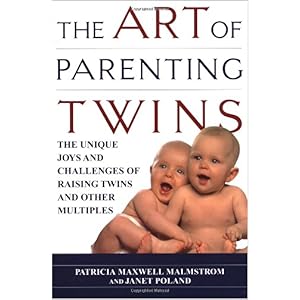
    Book Review: The Art of Parenting Twins

    The Art of Parenting Twins: The Unique Joys and Challenges of Raising Twins and Other Multiples by Patricia Maxwell Malmstrom and Janet Poland.

    I've quoted from this book in two previous posts, so you know I found it thought-provoking. In fact, it has a lot of good information.  And yet...  I find enough about this book off-putting that I can't give it a whole-hearted recommendation.  For example, the author (who refers to herself in the first person singular, even though there are two listed on the cover) rejects the terms "identical twin" and "fraternal twin".  Why?  Well, "identical twins" aren't completely identical, and "fraternal twins" aren't necessarily brothers.  Accurate, but tedious.  Don't get me wrong -- I like the terms "monozygotic" and "dizygotic" as much as the next parent, but there's no need to get strident about it.

    Other annoyances -- use of the term "co-twin" instead of "twin" and frequent references to "Twin Services", an organization she runs.  I know that organization is the source of much of the practical advice in the book, but it feels like an advertisement.

    I may be going out on a limb, but I found this part irritating:
    But it's awkward to refer to "twins and higher-order multiples" throughout the book, so we'll use the term twins to refer to all multiples.
    Why did I find this irritating?  Because after that, there are repeated references to triplets sprinkled throughout the book.  If you're going to go to the trouble of saying you'll call everybody twins, it's really jarring to read the triplet references.  I'll think, "Do I really need to read this part?",  "Shouldn't parents of triplets get their own books?", and "Twins don't seem so bad by comparison."

    Most memorable response to a stranger's question: this time the response comes from a twin himself.
    "If someone says, 'Are you twins?' I'll say, 'I am, but he's not.'"
    Parents of twins can adapt this to, "One of them is identical, and the other's fraternal, but I can never remember which is which."

    All in all, there's solid information contained in this book, if you can get past the style.  I couldn't, which is why the Twinometer is stuck at 7/10.

    Monday, April 5, 2010

    Book Review: It's Twins

    It's Twins!: Parent-to-Parent Advice from Infancy through AdolescenceOn a recent trip, I read It's Twins!: Parent-to-Parent Advice from Infancy through Adolescence by Susan Heim.  This book is divided into four parts: Twin Babies, Twin Toddlers and Preschoolers, Twin Kids, and Twin Tweens and Teens.  Each part contains a number of sections, such as "Should Twins Share Everything--Even Spit?", "Do You Have a Dominant Twin?", "The Importance of Family Traditions", and "Spending One-on-One Time with Your Twins."  Each section starts with an introduction, continues with a mini-essay or two (mostly a "Twins Tale" or "Twins Tips" but sometimes "Twins Trivia" and "Intriguing Twins"), and concludes with "Points to Ponder".

    "Twins Tale" is the meat of the book, and both its greatest strength and weakness.  These sections consist of essays written by parents of twins.  I appreciated the differing perspectives and the first-person perspective, rather than having everything filtered through the author's voice.  In some of the stories, however, the parent seemed to be venting rather than offering lessons for other parents.  Frankly, hearing how one hospital had stymied a mother's attempt to breastfeed, or how someone else's twin peed on the movie screen on a transpacific flight, just depressed me.

    The "Points to Ponder" was mostly filler -- three or four questions about your own twins, followed by large blank spaces for you to write your answer in the book.

    Now for what has apparently become a new feature in my book reviews -- most memorable response to a stranger's question.
    "A girl and a boy. Oh, you are so lucky; you got the best of both worlds. Are they identical?"
    "No, actually, my son was born with a penis and my daughter, thank the Lord, was not."

    I did find some parts of the book thought-provoking -- in particular, the list of advantages and disadvantages of putting twins in the same classroom sparked a lively discussion with Christina. Also, the broad scope of the book -- from birth through adolescence -- provided a nice overview at a time when I have no need to focus on one specific age.  Once the twins are actually here, though, I couldn't imagine keeping this book on the shelf for more than a decade waiting to use Part 4.

    This book is a nice one to take out of the library, skim through, and return when you're done.

    Twinometer: 6/10.

    Saturday, March 27, 2010

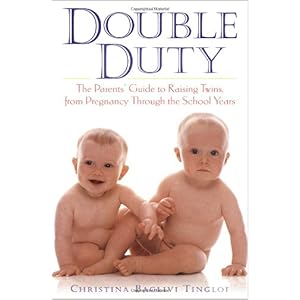
    Book Review: Double Duty

    Next up, I'm going to review Double Duty: The Parents' Guide to Raising Twins, from Pregnancy Through the School Years by Christina Baglivi Tinglof. I'm going to review the 1998 1st edition, rather than the 2009 2nd edition because, well, that's what I got from the library. I assume the second edition is fairly similar, but with fewer references to VCRs.

    At first this book intrigued me. Most books that we've been looking at focus on pregnancy and the first year. While this makes sense for us now, it seemed like it would be neat to "peek ahead" with a book that had a little less about pregnancy, a little more about the first year, and a couple of chapters about life beyond that.

    Unfortunately, my interest did not last long. Flipping through the book, I found the advice,
    Try not to refer to your children as "the twins".
    Really? Most parents I know talk about "the kids", "the boys", "the girls", etc. More to the point, why not? After some discussion, Christina (my wife, not Ms. Baglivi Tinglof) and I decided that it was reasonable to refer to them as "the twins" in the third person -- as in, "We just dropped off the twins with their grandparents, and we're headed for Vegas." It did, however, seem inappropriate to address them as such. ("Twins, get in here!") If we're going to be accused of causing lasting psychological damage to our kids, I'd at least like to know why.

    Reading the introduction, I see how the book was constructed. The author interviewed a bunch of parents of twins, and a pediatrician, and compiled the advice she got. The result, unfortunately, is a mix of good and bad advice, with little way to distinguish between the two.

    In the first chapter, she tells us,
    African races have the highest incidence of twinning (about 20 percent more likely than Caucasian women), followed by Europeans, then Mexicans. Asians have the lowest incidence.
    Reading this paragraph aloud provoked a lecture on Mexican racial identity from the Mexican-American in bed next to me. (Summary: It makes about as much sense to call Mexicans a race as it does to refer to the "United States race".)

    The author provides numerous Top Five lists. The "Top Five Comebacks to Annoying Questions and Comments" caught our eye, since we're planning to institute a similar feature here at twinpanic.com. (Preview: "Are they twins?" "No, they're triplets...oh, crap, one's missing again.") We were brought up short by #4:
    Question: "Twins? How do you tell them apart?"
    Answer: "We had only one twin circumcised."
    OK, at least we laughed at that one, but it seemed a little inappropriate.

    In short, I can't recommend this book; there are too many other, more carefully written books about twins out there. Even those which are also collections of advice are more explicit about the source of and reasoning behind that advice. This one's going back to the library soon.

    Twinometer: 3/10.

    Monday, March 8, 2010

    Book Review: Juggling Twins

    Juggling Twins: The Best Tips, Tricks, and Strategies from Pregnancy to the Toddler Years
    Christina and I are book people, so naturally we've been looking for books about twins.  The first one we looked at was Juggling Twins, by Meghan Regan-Loomis.

    This book was a good starting place for us.  It's not too serious, so it didn't overwhelm us with lists of things we were going to have to do.  It did, however, give us an idea of some of the things we are going to be up against.   The author definitely has her own perspective, which is both good and bad.

    Her perspective makes the book more entertaining than one written generically.  For example, she believes in significant weight gain during pregnancy.  She's also against co-bedding, and in favor of using "play yards" (apparently the term "play pen" has been lost to political correctness).  While I may not agree with all of her points of view, it's more interesting to read than wishy-washy advice.

    On the other hand, since she has an older child, much of the advice is given from that perspective.  We were panicked by the amount of help she said we'd need in the first month.  Towards the end of that chapter, we read the part that started, "The amount and type of help you need is determined in part by whether or not you have an older child or children."  Although we realize the first month will be tough, the specific prescriptions she gave grew out of her own experiences.  (We're still looking forward to your visit, Mom.)

    Now that I look at this book after a month or two, I see more good stuff in it (which baby goods are must haves and which are superfluous).  Still, I value it the most for the sense of perspective.  As such, it might be a good one to borrow from the library, if possible. 

    I think the part that sticks with me from the book is the following (for reasons I don't understand, it's presented as part of a poem):
    The next time we are shopping for tomatoes
    And yet another cart-pushing poet succumbs
    To the irrepressible need to proclaim "Double Trouble"
    Reading that was the moment where I realized, "Oh, no, people will be coming up to me to say stupid things in a grocery store.  I've structured much of my life around not having to talk to strangers."  In that moment, my twin panic grew by leaps and bounds.

    Twinometer: 6/10

    Sunday, February 28, 2010

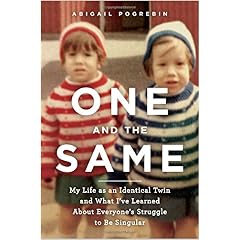
    Book Review: One and the Same

    I first learned of One and the Same from the author's blog entry at DoubleX. The text intrigued me enough to go over to Amazon and read a description of the book there. Lest you think the book is only of interest to parents of identical twins, Amazon says:
    If you’re considering IVF, if you are a twin or have a twin, or are married to a twin, or dating one, this book is a necessity.
    "Considering IVF"? Really? To be fair, the chapter on fertility treatments is more relevant to fraternal twins. But if IVF is your only interest, you can probably just read that chapter.

    What sold me on the book was the author's quote:
    My parents could not have been more loving, stimulating, or "modern" in their childrearing, but it literally never occurred to them to spend time with Robin and me separately and that omission backfired at the end of the day. When I interviewed my mother for my book, and asked her why she and Dad never took us anywhere separately, she looked pained. "Because we didn’t think that way," she told me. "We just thought in terms of doing things as a family. I should have been aware of it because I should have been smart enough to figure out that something is gained when you’re alone with a person. I should have realized that. But it never occurred to us. It always was a matter of 'Let’s. Not: 'You come with me and you go with him.'"

    She said they realized their mistake in one powerful instant when I was eighteen and they invited me to go with them for a weekend at a bed-and-breakfast. "You said you were uncomfortable coming along because you’d never been alone with us. It was like somebody shot us between the eyes; we couldn’t believe it. ‘How could this have happened?’ We never noticed that we had never been with one child."
    Reading this made me realize that having twins presents a unique set of challenges, and intrigued me enough to borrow the book from the library.

    My favorite parts were the opening chapter about the Twins Festival in Twinsburg, Ohio, the interviews with Tiki and Ronde Barber, and the author's recollections growing up as a twin. The Twinsburg chapter reads like a fun, goofy travelogue exploring the twee-er aspects of twinning. I don't expect we'll ever go, but it's a good reminder of what cultural niches exist for twins and their parents. The personal accounts of growing up a twin were interesting to read, and helped me see things from the perspective of the twin child rather than the parent, unlike most of the other books I've read which focus on the parent's point of view.

    The parts I didn't need to read (and skipped) were about twins in 9/11 or the Holocaust. While these sections are undoubtedly revealing for twins trying to understand their own identity or the role of twins in society, they are not something a future parent of twins wants to read.

    Twinometer: 7/10. I would have liked to rate it higher, but the parts I had to scan and skip dragged it down.